
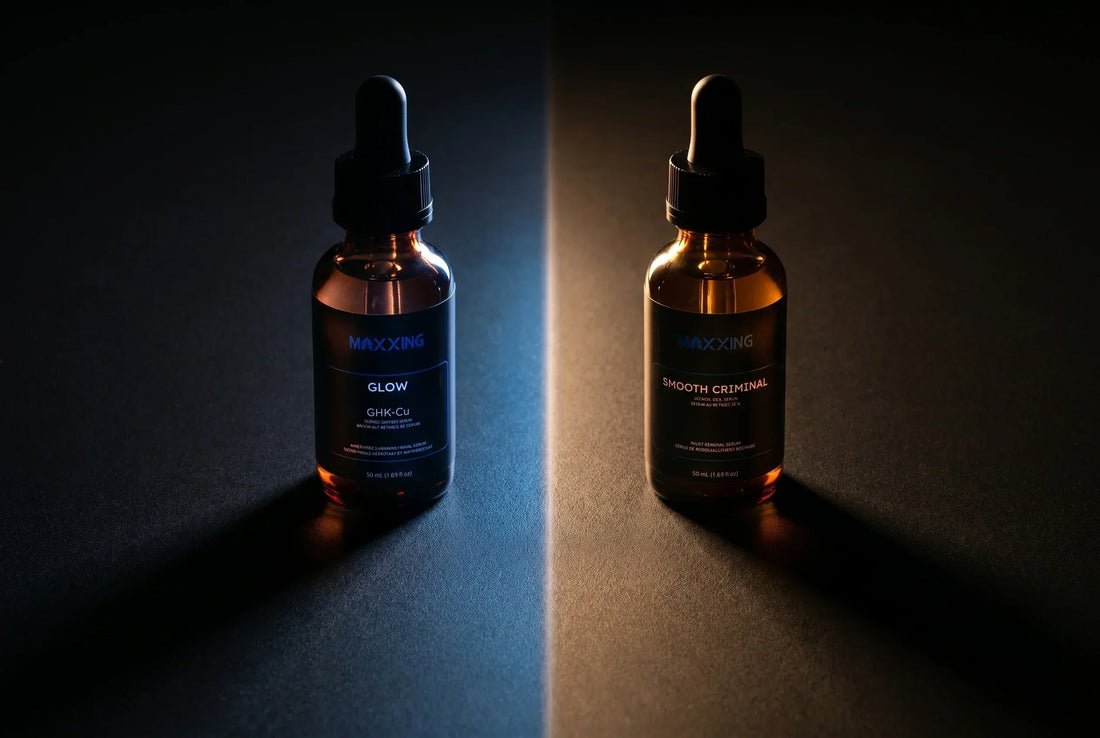

GHK-Cu Series / Comparison
Copper Peptides vs Retinol: Which Should You Use?
Copper peptides (GHK-Cu) and retinol are the two most evidence-backed topical anti-aging actives, and they work through entirely different mechanisms. In the only published head-to-head study, GHK-Cu supported improved collagen production in 70% of subjects versus 40% for tretinoin.[1] Retinol carries 50-plus years of large-scale clinical evidence and leads for texture, hyperpigmentation, and cell turnover. This guide breaks down what the research actually says, how to combine them, and how the leading products compare.
Copper peptides (GHK-Cu) build new collagen and modulate gene expression at the dermal level; retinol drives cell turnover and inhibits collagen-degrading enzymes at the epidermal level. Both work. Start with GHK-Cu if you are new to actives: zero irritation, no purging, no added sun sensitivity. Then layer in retinol on alternate nights once your skin has acclimated. Together they cover every major skin-aging pathway.
What's in This Guide
01 /The quick answer
Use both, but start with GHK-Cu copper peptide serum. Copper peptides have a flat entry curve: no irritation period, no purging, no added photosensitivity. That makes them the right first active if you are new to the category. Once your skin has settled over four to six weeks, add retinol on alternate nights at 0.25-0.5%.
If you had to pick one: GHK-Cu has broader biological reach (roughly 4,000 genes modulated versus 300-500 for retinol)[3] and a higher responder rate for collagen improvement in the only direct comparison.[1] Retinol is the stronger active for accelerating cell turnover, fading hyperpigmentation, and smoothing surface texture. They attack aging from different angles, so the combination is meaningfully better than either on its own.
GHK-Cu builds collagen from the dermal layer up. Retinol renews skin from the epidermal layer down. Start with GHK-Cu (no adjustment needed), add retinol after four to six weeks on alternate nights. Together they cover every major aging pathway. MAXXING's Glow GHK-Cu serum was formulated to be the copper peptide half of that stack.
02 /How they work: completely different mechanisms
Copper peptides (GHK-Cu): bottom-up repair
GHK-Cu (glycyl-L-histidyl-L-lysine complexed with copper) was first identified in human blood plasma in 1973 by Dr. Loren Pickart.[4] It occurs naturally in the body but declines with age, dropping from approximately 200 ng/mL at age 20 to around 80 ng/mL by age 60.[5] Applied topically, it works at the dermal level, the deeper structural layer where collagen, elastin, and glycosaminoglycans are produced.
The mechanism goes in multiple directions. In fibroblast cell studies, GHK-Cu stimulated collagen synthesis at nanomolar concentrations (10-9 M), which matters because it means effective activity at very low doses in well-formulated serums.[6] In rat wound models, it produced concentration-dependent increases in connective tissue accumulation with collagen synthesis twice that of non-collagen proteins.[7] Gene-expression analyses show GHK modulates approximately 4,000 human genes: around 1,600 involved in tissue repair and regeneration, with beneficial shifts in 47 DNA-repair genes and 17-18 antioxidant genes.[3] It also delivers copper ions for lysyl oxidase (which cross-links new collagen) and superoxide dismutase (an antioxidant defense enzyme).[8]
On concentration: clinical studies generally use 1-3% in optimized delivery systems. In practice, a well-formulated serum in the 0.1-1% range with good stability performs strongly because the molecule is active at very low levels. The full mechanism breakdown is in the GHK-Cu what to expect guide.
Retinol / tretinoin: top-down renewal
Retinol belongs to the vitamin A family. Once absorbed, it converts enzymatically, first to retinaldehyde, then to retinoic acid, which binds nuclear retinoic acid receptors (RARs) and drives cell-level changes. Tretinoin (all-trans retinoic acid) skips this conversion and binds RARs directly, which is why it acts faster but also causes more irritation. Tretinoin is prescription-only in the US, UK, Canada, and most markets; retinol at 0.1-1% is the over-the-counter path.
At the skin level, retinoic acid accelerates keratinocyte turnover: damaged surface cells shed faster and are replaced by newer ones, producing smoother texture and more even tone. Retinoids also inhibit matrix metalloproteinases (MMPs), the enzymes that break down existing collagen. That is defensive rather than constructive work.[9] A 52-week double-blind RCT with 0.1% stabilized retinol showed 44% improvement in crow's feet wrinkles and 84% improvement in mottled pigmentation, with benefits still accumulating at the final time point.[10]
GHK-Cu builds new structural matrix from the dermis up. Retinol clears and replaces damaged epidermal tissue from the surface down. Combined, they address aging from both directions at the same time.
03 /Clinical data: what the research actually shows
Abdulghani et al. (1998) is the only published head-to-head comparison. Creams containing GHK-Cu, vitamin C, or tretinoin were applied to thigh skin, and collagen was measured via biopsy analysis. GHK-Cu came in first.[1]
| Ingredient | Subjects with Improved Collagen | vs Tretinoin |
|---|---|---|
| GHK-Cu copper peptide | 70% | +75% higher responder rate |
| Vitamin C (L-ascorbic acid) | 50% | +25% higher responder rate |
| Tretinoin (retinoic acid) | 40% | Baseline comparator |
Outside this head-to-head, each ingredient has its own body of evidence. A randomized double-blind split-face trial found GHK-Cu supported a 55.8% reduction in measured wrinkle volume after eight weeks.[2] A 2023 study in the Journal of Cosmetic Dermatology found GHK-Cu and hyaluronic acid combined to synergistically upregulate collagen types I, IV, and VII.[11] For retinol, a systematic review identified it as the most clinically investigated retinoid derivative, though a separate systematic review specifically of OTC retinol products noted methodological limitations in much of the available evidence. Worth knowing going in.[12]
| Metric | GHK-Cu | Retinol / Tretinoin |
|---|---|---|
| Wrinkle improvement | 55.8% volume reduction at 8 wks[2] | 44% crow's feet at 52 wks (0.1% retinol)[10] |
| Collagen responder rate | 70% (direct comparison)[1] | 40% (direct comparison)[1] |
| Hyperpigmentation | Limited direct data; MMP inhibition may help indirectly | 84% improvement in mottled pigmentation at 52 wks[10] |
| Gene modulation scope | ~4,000 genes including 47 DNA-repair genes[3] | ~300-500 genes primarily epidermal |
| Onset (texture/hydration) | 2-4 weeks typical | 4-8 weeks (after adjustment period) |
| Wound healing | Accelerates; used in medical wound care[7] | Contraindicated on open or compromised skin |
| Total evidence volume | ~50 yrs, moderate human trial base | 50+ yrs, thousands of peer-reviewed studies |
A 2021 systematic review of OTC retinol trials concluded the available evidence had significant methodological gaps.[12] A 2020 review of GHK-Cu explicitly called for more well-designed human clinical trials.[13] Both ingredients are well-supported, and both have gaps in the clinical literature. Neither is "proven" in the pharmaceutical sense. They are cosmetic actives with meaningful, if imperfect, evidence bases.
04 /Side effects comparison
Retinol side effects
Retinol's side-effect profile is the main reason people quit before seeing results. The adjustment phase, sometimes called "retinization," typically involves two to six weeks of dryness, flaking, and redness as skin adapts to accelerated turnover. Purging (all congestion surfacing at once) is common. Retinol also increases UV sensitivity, so morning SPF is non-negotiable. A 2017 RCT confirmed that even a double-conjugated retinoid formulation caused significantly more erythema than vehicle, though it was more tolerable than standard tretinoin.[14] On sensitive or post-shave skin, retinol stings on micro-cuts and should be used with care.
GHK-Cu side effects
GHK-Cu's tolerability is one of its genuine clinical advantages. It occurs naturally in human plasma, carries no photosensitivity, and has no purging period. Major studies report no significant adverse events. Its anti-inflammatory profile, including suppression of TNF-alpha-dependent IL-6 secretion in dermal fibroblasts,[15] makes it appropriate even on sensitive, reactive, or post-procedure skin. The blue-green tint some serums show is just the copper ion; it washes off skin. One nuance worth knowing: starting at too-high frequency can trigger a temporary rough-texture phase sometimes called the copper peptide uglies. It is preventable. Start at two to three applications per week and build up gradually.
05 /Which should you start with?
Start with GHK-Cu. Zero adjustment, zero purging, zero sun sensitivity. It supports collagen from day one. Use it nightly for four to six weeks before adding retinol. Your skin barrier will be more resilient when you do introduce retinol, and user reports consistently show the adjustment period is milder after a GHK-Cu foundation. The MAXXING Glow GHK-Cu Serum was designed specifically for this entry-point role.
Exception: if you are already using retinol and it is working well, you do not need to stop. Add GHK-Cu on off-nights or in the morning. It pairs well with an established retinol protocol and counteracts some of the residual dryness and barrier disruption.
Guidance by skin type and goal
| Skin Type / Concern | Recommended Starting Active | Starting Concentration | Notes |
|---|---|---|---|
| Dry or sensitive | GHK-Cu first | 0.1-0.5% | Build barrier resilience before introducing retinol |
| Oily or acne-prone | Either; retinol may have edge for pore/texture | Retinol 0.25-0.5% | GHK-Cu on off-nights supports repair without worsening congestion |
| Combination (no prior actives) | GHK-Cu first | 0.1-0.5% | Easiest entry point; add retinol after 4-6 weeks |
| Mature skin (40+), deep wrinkles | Both, start GHK-Cu | GHK-Cu 0.5-1%; retinol 0.5-1% | Both actives operating simultaneously yields the broadest coverage |
| Primarily hyperpigmentation | Retinol has clearer evidence for this goal | Retinol 0.3-0.5% | GHK-Cu supports barrier health alongside; vitamin C in AM adds further tone-evening effect |
06 /When will you see results?
Timeline expectations are among the most searched questions in this category. Here is what the clinical evidence actually supports:
| Timeframe | GHK-Cu Copper Peptide | Retinol (0.3-1%) |
|---|---|---|
| 1-2 weeks | Improved hydration; skin feels plumper | Adjustment phase begins (dryness, flaking possible) |
| 4-6 weeks | Smoother texture; early firmness improvement visible | Adjustment settles; texture begins smoothing |
| 8-12 weeks | Measurable wrinkle reduction; visible firmness gain | Clearer fine-line reduction; pore appearance improving |
| 3-6 months | Deeper structural improvement in skin density | Significant hyperpigmentation improvement; wrinkle reduction sustained |
| 6-12 months | Maximum benefit from consistent daily use | 44% crow's feet improvement and 84% pigmentation improvement in 52-week data[10] |
The MAXXING copper peptides before and after guide covers the timeline in more detail, including before-and-after references and the typical progression week by week.
07 /Can you use copper peptides and retinol together?
Yes. Copper peptides and retinol work well together, as long as you do not layer them in the same step at the same time. The two simplest ways to run both: use them on alternate nights (copper peptides one evening, retinol the next), or split them across the day with copper peptides in the morning and retinol at night. Both approaches sidestep the pH clash that can happen when a peptide sits directly on top of a retinoid, and both let each active work in its own window.
If your skin leans sensitive, buffer the retinol: apply it over a light moisturizer, or keep it to two or three nights a week and let copper peptides carry the other evenings. Copper peptides are gentle and help skin feel calm, so they pair naturally with a retinoid that can be drying. Finish every morning with SPF, since sun protection is what preserves the results of both.
The protocols just below lay out three ready-to-follow routines. A dedicated deep-dive on combining copper peptides and retinol is coming to this blog soon, with more on sequencing, buffering and timing.
08 /How to combine them: three protocols
Protocol 1: alternate nights (best for beginners)
- Night A: Cleanse → MAXXING Glow GHK-Cu Serum → ceramide moisturizer
- Night B: Cleanse → retinol (0.25-0.5%) → ceramide moisturizer
- Every morning: Cleanse → niacinamide or vitamin C → moisturizer → SPF 30-50
Each ingredient gets 48 hours uninterrupted. No pH conflicts. Simple enough to build a consistent habit around. This is the MAXXING default recommendation for anyone starting out.
Protocol 2: AM/PM split (intermediate)
- Morning: Cleanse → MAXXING Glow GHK-Cu Serum → niacinamide → moisturizer → SPF
- Evening: Cleanse → retinol → ceramide moisturizer
This maximizes daily exposure to both actives. Morning GHK-Cu counteracts residual retinol barrier disruption and provides anti-inflammatory support throughout the day. Suited to people who have already established both actives separately.
Protocol 3: the MAXXING looksmaxxing stack (advanced)
- Daily morning: MAXXING Glow GHK-Cu → niacinamide → moisturizer → SPF 50
- 3 evenings/week: Cleanse → retinol 0.5-1% (or tretinoin 0.025-0.05%†) → ceramide moisturizer
- 4 evenings/week: Cleanse → MAXXING Glow GHK-Cu → ceramide moisturizer
† Tretinoin is prescription-only in the US, UK, Canada, and most markets. Consult a dermatologist before use.
This approach uses GHK-Cu as the primary active with retinol as a texture and turnover accelerator. Maximum collagen support plus retinoid surface benefits. More detail at the GHK-Cu looksmaxxing protocol and the broader Skinmaxxing 101 guide.
09 /GHK-Cu vs tretinoin: is prescription strength different?
Tretinoin is prescription-strength retinoic acid: faster and more powerful than over-the-counter retinol, but with more dryness, peeling, and sun sensitivity. GHK-Cu works on a separate pathway, supporting collagen from the dermal side with no irritation. They complement each other, so most people alternate them rather than choosing one.
The core distinction is potency and access. Retinol is an over-the-counter precursor that your skin converts in two steps (first to retinaldehyde, then to retinoic acid) before it becomes active. Tretinoin is that active retinoic acid already, so it binds skin receptors directly and acts faster. That speed is also why tretinoin tends to bring more of the retinoid adjustment phase: dryness, flaking, and temporary redness while skin adapts. Tretinoin is prescription-only in the US, UK, Canada, and most markets, so it is not something to add on your own. A 2017 split-face trial comparing retinoid creams confirmed that stronger retinoids drove more visible irritation than gentler formulations.[14]
GHK-Cu is not a retinoid at all, so comparing "strength" head to head misses the point. Instead of speeding up surface turnover, it signals fibroblasts in the deeper dermal layer to support collagen and elastin, and it carries copper for the enzymes that help cross-link new collagen. In the only published head-to-head skin study, GHK-Cu supported improved collagen in 70% of subjects versus 40% for tretinoin, though tretinoin still leads for surface texture and tone.[1] Because the two act on different layers and pathways, using both tends to cover more of the aging picture than either alone.
If you use prescription tretinoin, the simplest structure is to alternate: apply tretinoin on its own nights and use GHK-Cu on the nights in between, so skin gets recovery support without a pH or tolerance clash. Give any new retinoid several weeks to settle before layering in more actives, keep mornings focused on SPF, and follow the guidance of whoever prescribes your tretinoin. The alternating protocols above lay out a week-by-week structure.
10 /Vitamin C, retinaldehyde and bakuchiol: where they fit
Vitamin C
In the Abdulghani head-to-head, vitamin C landed between GHK-Cu (70%) and tretinoin (40%) with a 50% collagen responder rate.[1] It is a valuable complement to both actives, but the standard L-ascorbic acid form needs a low pH (around 2-3) to penetrate, and at that pH copper can dissociate from GHK, reducing the effectiveness of both. The simplest approach: vitamin C in the morning, GHK-Cu in the evening.
If you want to use both in the same routine, look for stable derivatives such as ascorbyl glucoside or MAP (magnesium ascorbyl phosphate) that operate at a higher pH and are copper-compatible. More on this in the niacinamide vs vitamin C guide.
Retinaldehyde (retinal): the gentler retinoid
Retinaldehyde sits one enzymatic step closer to retinoic acid than retinol. It converts more efficiently, meaning comparable skin effects at lower applied concentrations and a better tolerability profile. A clinical comparison found retinaldehyde comparable in efficacy to retinoic acid for photoaging while being better tolerated.[16] A 2024 observational study with 32 subjects applying retinaldehyde three nights per week for eight weeks showed 12% visible change in fine lines and 19% improvement in hyperpigmentation with no sensitization.[17] If standard retinol is too irritating, retinaldehyde is the next step down the retinoid hierarchy before reaching bakuchiol.
Bakuchiol: the plant-derived alternative
Bakuchiol is a meroterpene from Psoralea corylifolia that produces retinol-like outcomes through completely different receptor pathways. It does not bind classical retinoic acid receptors (RARs) the way retinoids do, which is why it carries none of retinol's photosensitivity or purging risk.[18] Gene-expression profiling shows it upregulates collagen types I, III, and IV and suppresses MMPs, mirroring retinol's effects via separate mechanisms.
The strongest clinical evidence: a 2019 randomized, double-blind 12-week trial in the British Journal of Dermatology (n=44) found 0.5% bakuchiol and 0.5% retinol produced comparable reductions in wrinkle surface area and hyperpigmentation, with retinol users reporting significantly more facial scaling and stinging.[19] Worth noting: some of the bakuchiol evidence base is industry-funded or open-label, which limits certainty.[20] Still, it is a solid option for anyone who cannot tolerate retinol, is pregnant, or wants a daytime-compatible vitamin-A alternative. GHK-Cu pairs well with bakuchiol and the two can be used in the same routine without pH conflict.
11 /Copper peptide serum product comparison
When choosing a GHK-Cu serum to use alongside retinol, a few factors matter: concentration, bottle size (price per ml is often more revealing than the headline price), formulation stability, and skin-type compatibility. Here is how the main options on the market compare to the MAXXING Glow GHK-Cu Serum.
| Product | GHK-Cu Concentration | Size | Price | Price / ml | Retinol-Compatible pH | Key Differentiator |
|---|---|---|---|---|---|---|
| MAXXING Glow GHK-Cu Serum Our Pick | 0.2% Copper Tripeptide-1 | 50 ml | $49.99 | $1.00/ml | Yes, optimal pH for copper stability | 50 ml bottle (vs 30 ml field); all skin types; clean formula; transparent % |
| Budget multi-peptide + copper serum (1% blend) | 1% total peptide complex (GHK-Cu as part of blend) | 30 ml | $32.00 | $1.07/ml | Yes, pH 6.00-7.00 | Budget-friendly; adds multi-peptide blend; bestseller format |
| Prestige dual-copper amino isolate serum | 1% GHK-Cu (Tripeptide-1 Copper Acetate) + 1% GHK peptide | ~30 ml implied | $62.00 | ~$2.07/ml | Yes, pH 5.7-6.7 | Multi-peptide formulation; premium price tier; no stated size on DTC page |
| Squalane-based copper peptide plumping serum | GHK-Cu (Copper Tripeptide-1 + Copper PCA, % undisclosed) | 50 ml | $69.00 | $1.38/ml | Yes | Added squalane, Paracress Extract; pregnancy-suitable; 1,200+ reviews |
| Prestige high-dose copper tripeptide + ectoin repair serum | 2% Copper Lysinate Complex + 1% Copper Tripeptide Complex | 30 ml | $199.00 | $6.63/ml | Yes | Highest copper dose; Ectoin for pollution defense; National Eczema Assoc. Seal |
| Budget single-peptide copper serum (0.10% GHK-Cu) | 0.10% Copper Tripeptide-1 (disclosed) | 30 ml (1 oz) | $21.99 | $0.73/ml | Yes | Lowest price per ml; minimal ingredient list; suitable for those starting out |
MAXXING's Glow Serum is a clean, optimally-dosed formula at 0.2% in a 50 ml bottle, designed for nightly use alongside retinol without compatibility concerns. The Skin Care collection covers the full MAXXING protocol stack. The best copper peptide serums guide goes deeper on formulation factors to look for.
12 /Frequently asked questions
Yes, but not layered on top of each other in the same step. Use on alternate nights (GHK-Cu one evening, retinol the next) or an AM/PM split (copper peptides in the morning, retinol in the evening). Separate application windows prevent pH conflicts and let each active work in optimal conditions. Many people find the alternate-night approach simplest to maintain.
If you are new to skincare actives, start with copper peptides (GHK-Cu). Zero adjustment: no purging, no peeling, no added UV sensitivity. Use consistently for four to six weeks, then introduce retinol at 0.25-0.5% on alternate nights. Skin that has been on a GHK-Cu routine typically handles the retinol adjustment period more smoothly. The MAXXING Glow Serum is built for this entry-point role.
They target wrinkles via different mechanisms, so "better" depends on the type of wrinkle and your skin's needs. GHK-Cu had a higher collagen responder rate (70% vs 40%) in the only direct comparison, and showed 55.8% wrinkle volume reduction at eight weeks in a split-face trial. Retinol, over longer periods, is well-established for surface fine lines and texture improvement. For deep structural wrinkles, GHK-Cu's dermal action may be more direct; for surface texture and pigmentation, retinol is the stronger active. Most people benefit from both.
No. GHK-Cu does not drive accelerated cell turnover, which is the underlying mechanism of retinol purging. A small proportion of people experience a temporary rough-texture phase sometimes called the copper peptide uglies, thought to be driven by MMP activity briefly outpacing new collagen synthesis when starting at too high a frequency. It is entirely preventable: start at two to three applications per week and build up gradually. Most people experience no adjustment phase at all.
Tretinoin is the active form (all-trans retinoic acid) that binds retinoic acid receptors directly. Retinol is an OTC precursor that requires two enzymatic conversion steps in the skin, which reduces effective potency but also reduces irritation. Tretinoin is prescription-only in the US, UK, Canada, and most markets. 0.025-0.05% prescription tretinoin and 0.5-1% OTC retinol produce broadly comparable photoaging outcomes in head-to-head trials, though tretinoin acts faster. The 2024 systematic review in the American Journal of Clinical Dermatology found most retinoin alternatives had comparable or slightly lower efficacy but better tolerability profiles.
Two options with genuine clinical support: Retinaldehyde (retinal) sits one step closer to retinoic acid than retinol, so it converts more efficiently with less irritation than standard retinol. A 2024 clinical study found it produced 12% improvement in fine lines and 19% in hyperpigmentation applied three nights per week for eight weeks with no sensitization. Bakuchiol is a plant-derived meroterpene that produces retinol-like collagen gene expression without binding retinoid receptors: no photosensitivity, no purging, pregnancy-compatible. A 2019 RCT found bakuchiol 0.5% comparable to retinol 0.5% for wrinkles and pigmentation with significantly less skin scaling. GHK-Cu pairs well with both alternatives and can be used in the same routine without pH conflict. See the GHK-Cu microneedling protocol for advanced combination approaches.
L-ascorbic acid needs a pH of around 2-3 to penetrate effectively, and at that pH copper can dissociate from the GHK peptide, diminishing both ingredients. The standard solution: vitamin C in the morning, GHK-Cu in the evening. Stable vitamin C derivatives (ascorbyl glucoside, MAP / magnesium ascorbyl phosphate) operate at neutral pH and can be layered with GHK-Cu without conflict. More detail in the niacinamide vs vitamin C guide.
GHK-Cu signals fibroblasts to synthesize collagen types I and III, elastin, and glycosaminoglycans. It delivers copper ions for lysyl oxidase (which cross-links new collagen into functional fibers) and superoxide dismutase (an antioxidant enzyme). At the gene level, it modulates roughly 4,000 human genes, activating around 1,600 involved in repair and regeneration while suppressing age-related inflammatory pathways. GHK naturally declines with age from approximately 200 ng/mL in plasma at age 20 to around 80 ng/mL by age 60. Topical application aims to restore that signaling activity at the skin level. More in the GHK-Cu looksmaxxing guide.
Korean skincare routines commonly reach for bakuchiol and copper peptides (GHK-Cu) as retinol alternatives. Bakuchiol is a plant-derived meroterpene that supports retinol-like collagen gene expression without retinol's photosensitivity or purging risk. A 2019 RCT found 0.5% bakuchiol comparable to 0.5% retinol for wrinkle and pigmentation outcomes with less scaling. GHK-Cu is valued for its tolerability and its direct support of collagen synthesis, making it a practical daily-use alternative on nights when retinol is not in the rotation.
GHK-Cu has a clean tolerability profile, but a few things are worth knowing. Starting at too-high a frequency can trigger a temporary rough-texture phase (sometimes called the copper peptide uglies) caused by MMP activity briefly outpacing new collagen synthesis. It is preventable: begin at two to three applications per week and increase gradually. The blue-green tint in some serums is just the copper ion and washes off. GHK-Cu also has a smaller total clinical evidence base than retinol, and L-ascorbic acid vitamin C should be kept in a separate routine step to avoid pH-driven instability.
Yes. GHK-Cu and tretinoin work on different pathways, so they pair well when you separate them in time. The common approach is alternating nights: tretinoin on its own evenings and GHK-Cu on the nights between, which gives skin recovery support without a tolerance or pH clash. Introduce tretinoin slowly, keep up morning SPF, and follow the guidance of whoever prescribes it. Avoid layering both in the same step.
References
- Abdulghani AA, et al. "Studies on the effects of topical glycyl-L-histidyl-L-lysine copper in various aging models." Dis Manag Clin Outcomes. 1998;1(4):136-141.
- Badenhorst T, et al. "Clinical efficacy of GHK-Cu peptide in wrinkle reduction: a split-face randomized double-blind trial." J Aging Sci. 2016;4(3):166.
- Pickart L, Margolina A. "Regenerative and protective actions of the GHK-Cu peptide in the light of the new gene data." Int J Mol Sci. 2018;19(7):1987. PubMed
- Pickart L. "Tripeptide in human serum which prolongs survival of normal liver cells." Nature New Biology. 1973. PubMed
- Pickart L, et al. "GHK peptide as a natural modulator of multiple cellular pathways in skin regeneration." BioMed Res Int. 2015;648108. PubMed
- Maquart FX, et al. "Stimulation of collagen synthesis in fibroblast cultures by the tripeptide-copper complex glycyl-L-histidyl-L-lysine-Cu²⁺." FEBS Lett. 1988;238(2):343-346. PubMed
- Maquart FX, et al. "In vivo stimulation of connective tissue accumulation by the tripeptide-copper complex glycyl-L-histidyl-L-lysine-Cu²⁺ in rat experimental wounds." J Clin Invest. 1993;92(5):2368-2376. DOI: 10.1172/JCI116842
- Borkow G. "Using copper to fight microorganisms." Curr Chem Biol. 2012;6(2):93-103. See also: Beneficial regulation of fibrillar collagens by copper in dermal fibroblasts. Connect Tissue Res. 2012. PubMed
- Fisher GJ, et al. "Molecular mechanisms of photoaging in human skin in vivo and their prevention by all-trans retinoic acid." Photochem Photobiol. 1999;69(2):154-157. PubMed
- Kafi R, et al. "One-year topical stabilized retinol treatment improves photodamaged skin in a double-blind, vehicle-controlled trial." J Drugs Dermatol. 2015;14(3):271-280. PubMed
- Tian Y, et al. "Synergy of GHK-Cu and hyaluronic acid on collagen IV upregulation via fibroblast and ex-vivo skin tests." J Cosmet Dermatol. 2023;22(8):2270-2279. DOI: 10.1111/jocd.15763
- Zasada M, Budzisz E. "Retinoids: active molecules influencing skin structure formation in cosmetic and dermatological treatments." Postepy Dermatol Alergol. 2019;36(4):392-397. See also: Mukherjee S, et al. "Retinoids in the treatment of skin aging." Clin Interv Aging. 2006;1(4):327-348. PubMed; and OTC retinol systematic review: JCAD 2021
- Pickart L, Margolina A. "The potential of GHK as an anti-aging peptide." Aging Pathobiol Ther. 2020;2(1):30-37. PubMed
- Dhaliwal S, et al. "Efficacy and tolerability of a double-conjugated retinoid cream vs 1.0% retinol or 0.025% tretinoin." J Cosmet Dermatol. 2017;16(3):317-323. PubMed
- Gruchlik A, et al. "Effect of Gly-Gly-His, Gly-His-Lys and their copper complexes on TNF-alpha-dependent IL-6 secretion in normal human dermal fibroblasts." Acta Pol Pharm. 2012;69(6):1303-1306. PubMed
- Creidi P, et al. "Profilometric evaluation of photodamage after topical retinaldehyde and retinoic acid treatment." J Am Acad Dermatol. 1998;39(6):960-969. PubMed
- Goldfaden R, et al. "The clinical efficacy and tolerability of a novel retinaldehyde serum with firming peptides." J Drugs Dermatol. 2024;23(10). PubMed
- Chaudhuri RK, Bojanowski K. "Bakuchiol: a retinol-like functional compound revealed by gene expression profiling." Int J Cosmet Sci. 2014;36(3):221-230. PubMed
- Dhaliwal S, et al. "Prospective, randomized, double-blind assessment of topical bakuchiol and retinol for facial photoageing." Br J Dermatol. 2019;180(2):289-296. PubMed
- Spierings NMK. "Cosmetic commentary: Is bakuchiol the new 'skincare hero'?" J Cosmet Dermatol. 2020;19(12):3208-3209. PubMed
